
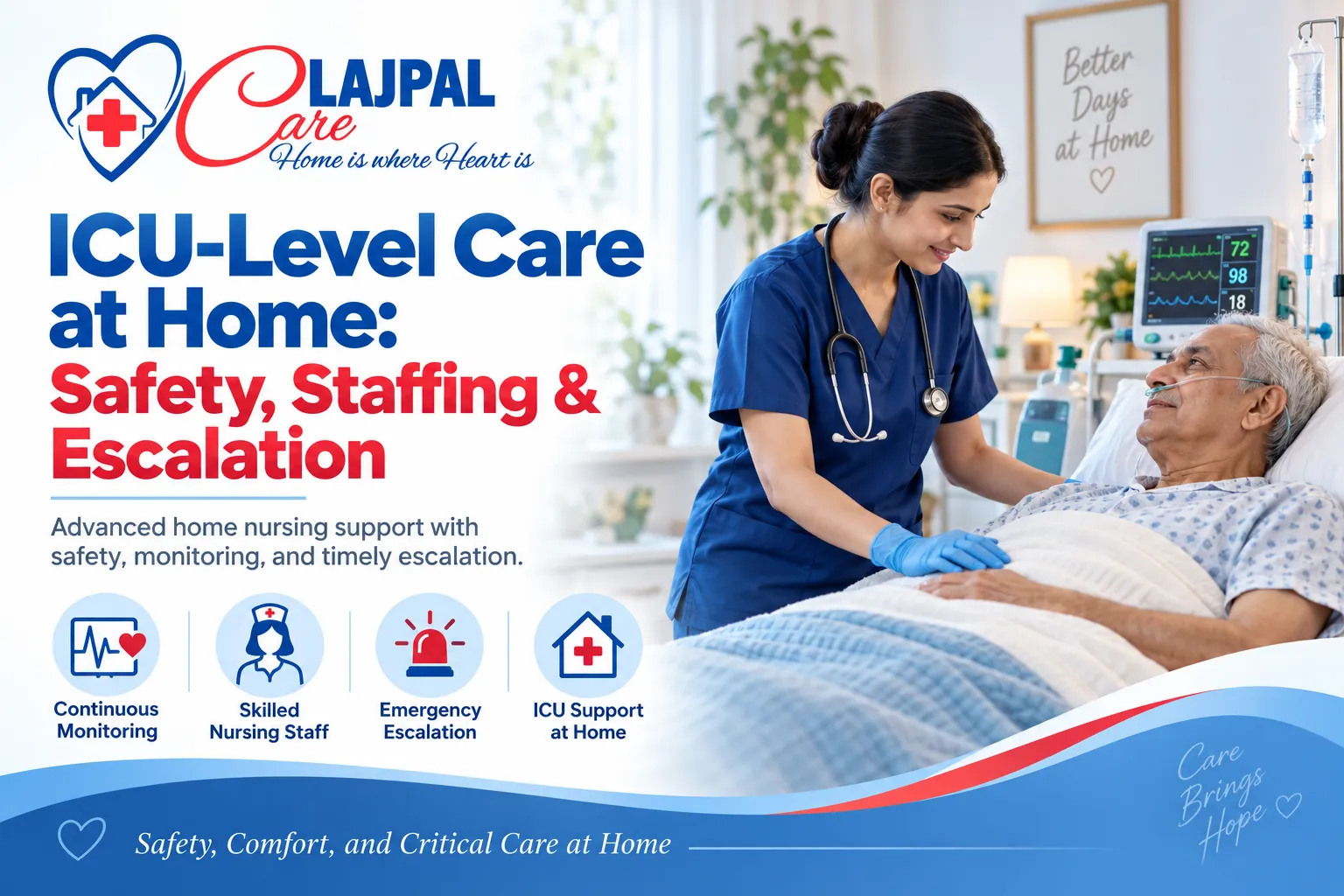
Families caring for a medically complex patient may eventually hear terms such as “ICU care at home,” “home ICU,” “critical care nursing at home” or “ICU-level home nursing.”
These terms can be useful descriptions of high-dependency home-care services, but one distinction is essential:
ICU-level care at home does not mean that a private residence becomes clinically identical to a hospital intensive-care unit.
A hospital ICU has immediate access to multidisciplinary medical teams, diagnostics, emergency procedures, pharmacy systems and other hospital resources that cannot simply be recreated by placing medical equipment inside a bedroom.
Home-based critical care should therefore begin with a different question:
Is this patient medically suitable for care at home, and can the required nursing, equipment, monitoring, backup arrangements and emergency escalation pathway be provided safely?
For families considering ICU care at home in Islamabad or a critical care nurse in Rawalpindi, this guide explains the safety questions that should be answered before the first home-care shift.
This article is general educational information. Patient-specific decisions should come from the treating clinical team.
What Does “ICU-Level Care at Home” Actually Mean?
In a home-care context, ICU-level or critical-care nursing may describe support for a patient with more complex clinical requirements than routine home nursing.
Depending on the patient's prescribed plan, this can involve areas such as:
- Higher-dependency nursing observation
- Oxygen therapy
- Tracheostomy-related care
- Suction support
- Ventilator-related nursing support
- BiPAP or CPAP-related monitoring
- Multi-parameter monitoring
- Feeding tubes
- Urinary catheters
- Complex wound care
- Medication administration
- Positioning and pressure-injury prevention
- Documentation and shift handover
However, the presence of an oxygen concentrator, monitor, suction machine or ICU-style bed does not by itself make a home an ICU.
Safe complex home care requires the right combination of:
clinical suitability + competent professionals + prescribed equipment + written care plan + contingency arrangements + escalation pathway.
Start With Clinical Suitability, Not Equipment
One of the biggest mistakes families can make is ordering medical equipment first and deciding later whether the patient is actually suitable for home care.
The process should work in the opposite direction.
Step 1: The Treating Team Defines the Medical Plan
The patient's treating clinician or clinical team should establish:
- Whether the patient is sufficiently stable for the proposed home environment
- What ongoing treatment is required
- What monitoring is required
- What devices are required
- What nursing competencies are needed
- What warning signs require medical review
- What should trigger emergency transfer
A home-care company should not independently replace this medical decision-making process.
Step 2: Match Nursing Competency to the Patient
After the patient's clinical requirements are understood, the provider can determine what professional skills are required.
A patient with routine daily-living needs may need a very different staffing arrangement from a patient with:
- Tracheostomy
- Respiratory equipment
- Suction requirements
- Feeding tubes
- Multiple medical devices
- Complex wounds
- High-dependency monitoring
The family should ask for the professional role, relevant credentials and competency of the person assigned to the case.
Step 3: Confirm Equipment and Supplies
Only after the clinical plan is established should the family and provider confirm the equipment required for that individual patient.
Step 4: Create the Emergency Plan
The escalation process should be written before care starts—not created during an emergency.
Home Critical-Care Readiness Checklist
Before moving a complex patient into a home-care arrangement, review the following areas.
1. Written Clinical Care Plan
The team should understand:
- Diagnosis and current clinical situation
- Prescribed medicines
- Required procedures
- Monitoring instructions
- Respiratory or device requirements
- Feeding plan where relevant
- Mobility and positioning needs
- Wound-care instructions
- Follow-up appointments
- Patient-specific warning signs
- Emergency instructions
The home nurse should not be expected to invent treatment decisions that are missing from the clinical plan.
2. Appropriate Nursing Professional
Ask:
- What is the assigned person's professional category?
- What qualifications do they hold?
- Are professional registration/verification requirements applicable?
- Have they managed similar types of patients?
- Are they competent with the specific devices involved?
- Who provides clinical supervision?
- Who can the nurse contact for clinical concerns?
For complex care, a generic statement such as “trained staff available” is less useful than showing how the professional's competency matches the patient's actual needs.
3. Prescribed Equipment
Equipment should be selected according to the patient's documented requirements.
Depending on the clinical plan, home-care equipment might include items such as:
- Patient monitor
- Oxygen concentrator
- Suction device
- Appropriate patient bed
- Other prescribed respiratory or monitoring equipment
Not every patient requires every device.
More equipment does not automatically mean safer care.
4. Consumables and Supplies
A complex home-care plan should identify the required consumables.
Families should know:
- Which items are required
- Who supplies them
- How replacement stock is managed
- Where essential supplies are stored
- Who checks stock levels
Running out of necessary supplies during a shift should not be the first indication that no restocking process exists.
5. Power and Equipment Contingency
If the patient relies on electrically powered equipment, the care-readiness assessment should address what happens during a power interruption or equipment problem.
The exact backup arrangement should be appropriate to the prescribed equipment and patient's clinical needs.
Questions to ask include:
- Which devices require continuous electricity?
- Is backup power required for the prescribed setup?
- What happens if a device stops functioning?
- Who provides technical support?
- Is replacement equipment available?
- What is the emergency plan if essential support cannot continue?
Do not assume a generic household backup arrangement is adequate for every medical device.
6. Oxygen Contingency
If oxygen is part of the prescribed plan, the family should understand how the oxygen supply will be maintained and what the contingency plan is if the primary setup becomes unavailable.
The appropriate arrangement should be established according to the patient's prescribed clinical requirements.
7. Infection-Prevention Plan
Complex home nursing can involve procedures where infection prevention is particularly important.
Examples include:
- Tracheostomy-related procedures
- Suction procedures
- Wound dressing
- Catheter care
- Feeding-tube care
- Other clean or aseptic procedures
Appropriate hand hygiene and procedure-specific infection-control practices should be part of the care plan.
8. Family Orientation
Family members should know:
- What the nurse is responsible for
- What the family is responsible for
- Which equipment should not be adjusted without instruction
- Whom to contact with questions
- What warning signs require escalation
- How to call for emergency help
Home critical care should not depend on family members guessing what to do when something changes.
Tracheostomy Care at Home
Some medically stable patients with a tracheostomy may receive appropriate nursing support at home when the required clinical plan, professional competency, equipment and escalation arrangements are in place.
Tracheostomy-related home care can involve responsibilities such as:
- Observation according to the prescribed plan
- Appropriate hygiene
- Suction-related care where ordered and within competency
- Equipment checks
- Documentation
- Recognizing changes that require escalation
Because tracheostomy patients can have very different clinical needs, the website or home-care worker should not create generic treatment instructions for an individual patient.
The treating team should establish the required procedures and emergency plan.
For families looking for complex home nursing in Islamabad, see:
Professional Home Nursing Services in Islamabad
https://homepatientcareservices.com/islamabad/services/home-nursing-services
Suction Support at Home
Suction equipment may be included in some complex home-care arrangements where clinically required.
Safe use depends on:
- The patient's clinical plan
- Correct equipment
- Competent staff
- Appropriate supplies
- Infection-control procedures
- Clear instructions for escalation
The presence of a suction machine should not be treated as proof that a provider is automatically capable of managing every respiratory patient.
Ask specifically who has been assigned and whether their competency matches the patient's requirements.
Ventilator, BiPAP and CPAP-Related Home Nursing
Some patients may be discharged with prescribed respiratory support.
Whether home care is appropriate depends on factors such as:
- Clinical stability
- Treating team's plan
- Type of respiratory support
- Monitoring requirements
- Nursing competency
- Home environment
- Equipment
- Power contingency
- Emergency plan
A patient using respiratory support should not be judged suitable or unsuitable for home care based on an internet article.
That decision should be individualized.
Oxygen Nursing Care at Home
Oxygen therapy is another service commonly associated with home critical care.
Families should understand:
- What oxygen delivery system has been prescribed
- Who is authorized to change settings
- What monitoring is required
- How supplies are maintained
- What backup arrangements are required
- What warning signs require escalation
A home nurse should follow the patient's prescribed care plan rather than independently changing treatment parameters.
Tubes and Catheters in Complex Home Care
Some complex patients may also have medical devices such as:
- Urinary catheter
- NG tube
- PEG/feeding tube
- Other prescribed devices
Each device requires an appropriate care plan.
For urinary catheters, recognized safety principles include maintaining an appropriate closed drainage system and unobstructed urine flow.
For feeding tubes and other devices, staff competency should match the procedure being assigned.
Families should ask:
“Who is responsible for this device, what procedures are included, and what should happen if there is a problem?”
What Does 24-Hour Nursing Mean?
The phrase “24-hour nursing care” can mean different things between providers.
It should not automatically be interpreted as meaning that one person performs continuous active clinical work for an entire 24-hour period without an explained staffing or rest arrangement.
Before booking, ask the provider to state the staffing model clearly.
For example:
- Is there one live-in worker?
- Are nurses rotating by shift?
- Is the model nurse plus attendant?
- How are rest periods managed?
- Who provides relief?
- What happens when the assigned staff member is absent?
- Who is clinically responsible for the case?
- How is shift handover documented?
The correct model depends on the patient and the service being purchased.
For 24-hour nursing care in Rawalpindi, families can review:
Professional Home Nursing Services in Rawalpindi
https://homepatientcareservices.com/rawalpindi/services/home-nursing-services
Before confirming the package, request the actual staffing arrangement in writing.
Why Shift Handover Matters
Complex patients often have several care requirements at the same time.
Important information can be lost if one worker finishes duty and the next begins without a structured handover.
A handover may include information relevant to the patient's plan such as:
- Current clinical status
- Relevant observations
- Medicines administered
- Procedures completed
- Respiratory/device status
- Feeding information
- Urine output or catheter concerns where relevant
- Wounds and skin observations
- Positioning
- Changes during the shift
- Calls to doctor or supervisor
- Pending instructions
- Supplies requiring replacement
Documentation creates continuity.
Without it, the family may repeatedly have to explain the entire case to every new worker.
Build the Escalation Plan Before the First Shift
An escalation plan is one of the most important parts of complex home care.
It should answer:
Who Does the Nurse Call First?
Depending on the patient's plan, this might involve:
- Clinical supervisor
- Treating clinician
- Designated medical contact
- Emergency medical service
The order should be clear.
What Patient-Specific Warning Signs Matter?
These should come from the treating medical plan.
The home-care company should not replace the patient's clinician by creating arbitrary medical thresholds without appropriate clinical direction.
How Will the Patient Be Transported?
If hospital transfer becomes necessary, the family should know how transport will be arranged.
Where Will the Patient Go?
Where appropriate, the treating team/family should understand the intended escalation destination.
Do not wait until a patient's condition deteriorates to begin deciding these basic questions.
Islamabad and Rawalpindi Hospital Backup
Families arranging complex home care in the Twin Cities should maintain a realistic emergency and hospital-transfer pathway.
PIMS can be considered part of the broader Islamabad hospital context, while Rawalpindi Medical University's system includes institutions such as Holy Family Hospital and Benazir Bhutto Hospital.
Mentioning these hospitals as local healthcare context does not mean they are partners of Lajpal Care.
Hospital partnership claims should only be made where a genuine relationship exists and can be documented.
The important point for the family is that complex home care should always include a practical route back to hospital-level care when required.
What Happens If the Patient Deteriorates?
Home nursing should not become a reason to delay urgent medical treatment.
If the patient develops clinical deterioration or a condition identified in the written escalation plan:
- Follow the patient's treating team's instructions.
- Contact the appropriate clinical or emergency service.
- Use the agreed transfer pathway when necessary.
- Document the event and actions taken.
Do not rely on a website article to determine whether a complex symptom is an emergency.
Equipment Does Not Replace Skilled Nursing
A room can contain:
- ICU-style bed
- Oxygen concentrator
- Suction machine
- Monitor
- Respiratory equipment
and still be unsafe if the people providing care do not understand the patient's condition or the devices.
The opposite is also true.
A skilled nurse cannot safely provide every type of critical care without the required equipment, supplies, clinical plan and escalation support.
Safe care requires all of these components to work together.
Questions to Ask Before Booking ICU-Level Home Care
Before paying for an ICU-style or complex home-care package, ask the provider these questions:
Clinical Suitability
- Has the treating clinical team indicated that home care is appropriate?
- Is there a written care plan?
- What medical monitoring is required?
Nursing Staff
- What professional category will be assigned?
- How are credentials verified?
- Does the professional have relevant competency for this patient?
- Who is the clinical supervisor?
- Who replaces the nurse if they are unavailable?
24-Hour Staffing
- What exactly does “24-hour care” mean?
- How many staff members are involved?
- Are shifts rotated?
- How are rest and relief handled?
- How is handover documented?
Equipment
- Which devices are clinically required?
- Who supplies them?
- Who maintains them?
- What happens if equipment fails?
- Is there a backup arrangement?
Oxygen and Power
- What power contingency is required?
- What oxygen contingency is required?
- Who checks that backup arrangements remain functional?
Consumables
- Which supplies are needed?
- Are they included in the quotation?
- Who monitors stock?
Documentation
- Will each shift be documented?
- Will medication and procedures be recorded?
- How are changes communicated to the family and clinical supervisor?
Physician Coordination
- Who communicates with the treating clinician?
- How are new medical instructions documented?
- Who can authorize changes in the care plan?
Emergency Plan
- What warning signs require escalation?
- Who is contacted?
- What transport arrangement is available?
- What is the hospital-transfer pathway?
Pricing
- What exactly is included in the package?
- Are nursing, equipment and consumables separate?
- Are additional procedures charged separately?
- What circumstances can change the price?
A Simple ICU-Level Home Care Readiness Pathway
A safe decision process should broadly follow this order:
1. Complex patient is being considered for home care
↓
2. Treating clinician defines the medical requirements
↓
3. Patient is assessed as appropriate for the proposed home setting
↓
4. Required nursing competency is identified
↓
5. Equipment and supplies are confirmed
↓
6. Power, oxygen and equipment contingencies are addressed
↓
7. Written emergency escalation plan is completed
↓
8. Family receives orientation
↓
9. Nursing handover is completed
↓
10. Documented home care begins
↓
11. Patient is regularly reassessed according to the clinical plan
If deterioration occurs, the team should follow the established medical escalation or emergency-transfer pathway.
What Makes a Complex Home-Care Provider More Trustworthy?
Families should look beyond advertising phrases such as:
- “Best ICU at home”
- “Hospital care at home”
- “Fully equipped ICU”
- “24/7 expert nursing”
More useful trust signals include:
- Clearly identified professional roles
- Verifiable nursing credentials
- Relevant competency records
- Named clinical supervision
- Written care plans
- Shift documentation
- Backup staffing policy
- Equipment-maintenance process
- Equipment contingency planning
- Written escalation pathway
- Transparent pricing
- Properly documented partnerships where claimed
For high-dependency patients, clinical governance matters more than a long equipment list.
Home Care and Hospital Care Should Work Together
The purpose of appropriate ICU-style home nursing is not to prove that hospital care is unnecessary.
A better model is continuity.
Hospital and treating teams establish the medical plan.
Home nursing supports appropriate care between reviews.
The patient's condition is documented.
Changes are communicated.
When the patient's needs exceed what can safely be managed at home, the escalation pathway returns the patient to the appropriate level of medical care.
That is a safer definition of complex home nursing.
Section 2: CTA – Request a Critical-Care Readiness Assessment
Complex home care should begin with a suitability assessment—not an equipment order.
Before arranging ICU-style or 24-hour nursing, request a documented care-readiness assessment covering:
- Treating clinician's plan
- Patient's medical stability
- Nursing professional required
- Relevant staff competency
- 24-hour staffing model
- Respiratory or other medical devices
- Equipment and consumables
- Power and oxygen contingency
- Infection-prevention requirements
- Nursing documentation
- Clinical supervision
- Backup staffing
- Emergency contacts
- Hospital-transfer pathway
ICU & Complex Home Nursing in Islamabad
Review available:
Professional Home Nursing Services in Islamabad
https://homepatientcareservices.com/islamabad/services/home-nursing-services
24-Hour & Complex Nursing in Rawalpindi
Review available:
Professional Home Nursing Services in Rawalpindi
https://homepatientcareservices.com/rawalpindi/services/home-nursing-services
Lajpal Care / Home Patient Care Services
If you are considering ICU-style nursing at home, ask for the proposed staffing model, professional credentials, required equipment and emergency-escalation pathway in writing before the first shift begins.
Frequently Asked Questions
Some patients receiving prescribed respiratory support may be cared for at home when their treating clinical team considers the home setting appropriate and the necessary equipment, competent nursing staff, monitoring, contingency planning and escalation pathway are available. Suitability must be determined individually rather than from a general website checklist.
No. “ICU-level care at home” describes higher-dependency nursing and medical support provided in a residence. It does not mean that a home has all the staff, diagnostics, emergency procedures and resources available in a hospital intensive-care unit.
The patient's treating clinical team should determine medical stability, ongoing treatment requirements and whether the proposed home-care setting is appropriate. The home-care provider should then determine whether it can safely provide the prescribed staffing, equipment and support.
There is no universal equipment list for every patient. Equipment should be selected according to the prescribed care plan. Depending on the patient's requirements, services may involve monitoring equipment, oxygen equipment, suction devices, an appropriate patient bed or other prescribed devices. More equipment should not be ordered simply to make a room appear like an ICU.
The family and nursing team should follow the patient's written clinical escalation and emergency plan. This should identify relevant warning signs, who should be contacted, how emergency transport will be arranged and the appropriate hospital-transfer pathway. Home nursing should never be used to delay necessary emergency medical treatment.