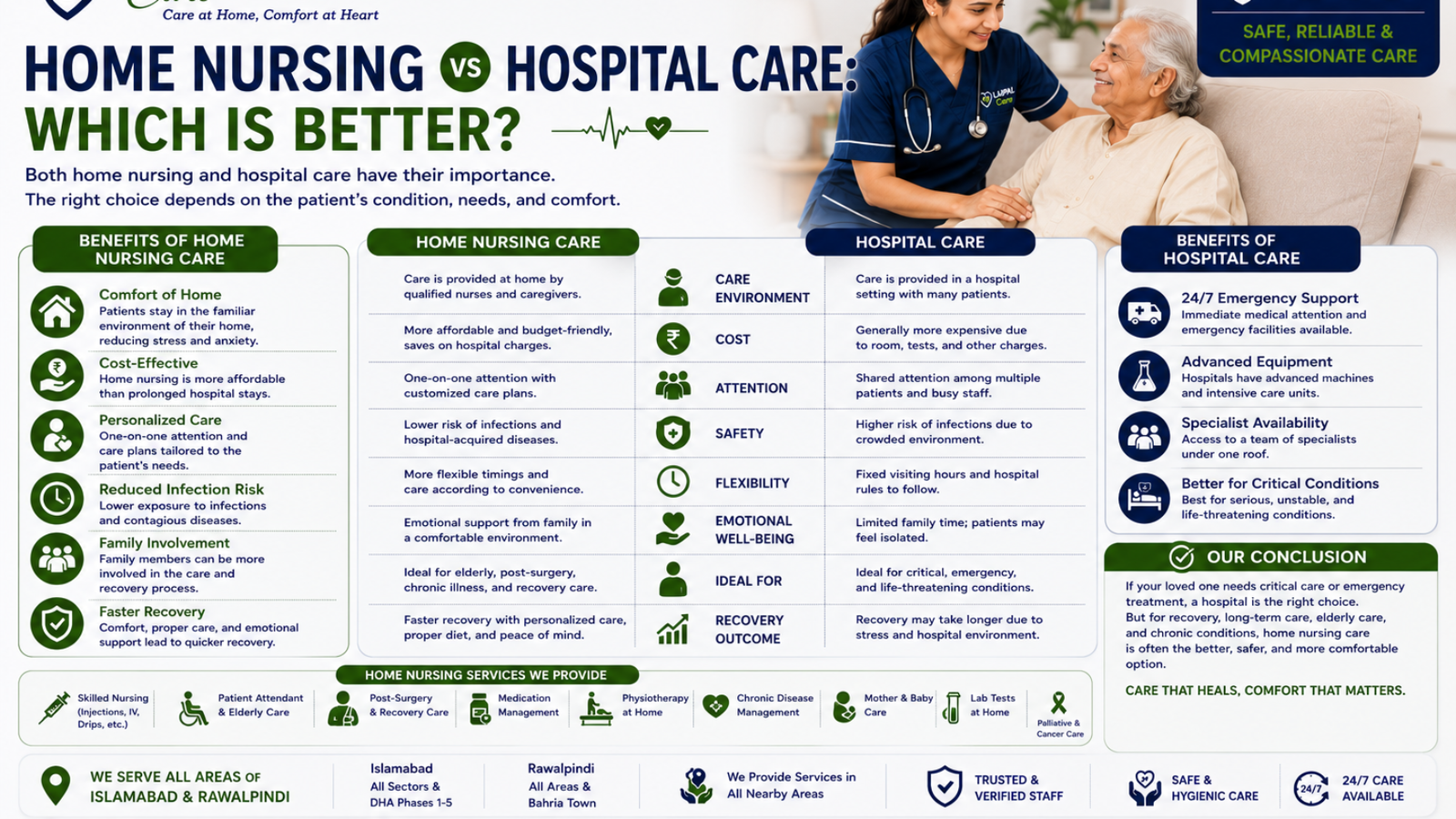
Home Nursing vs Hospital Care

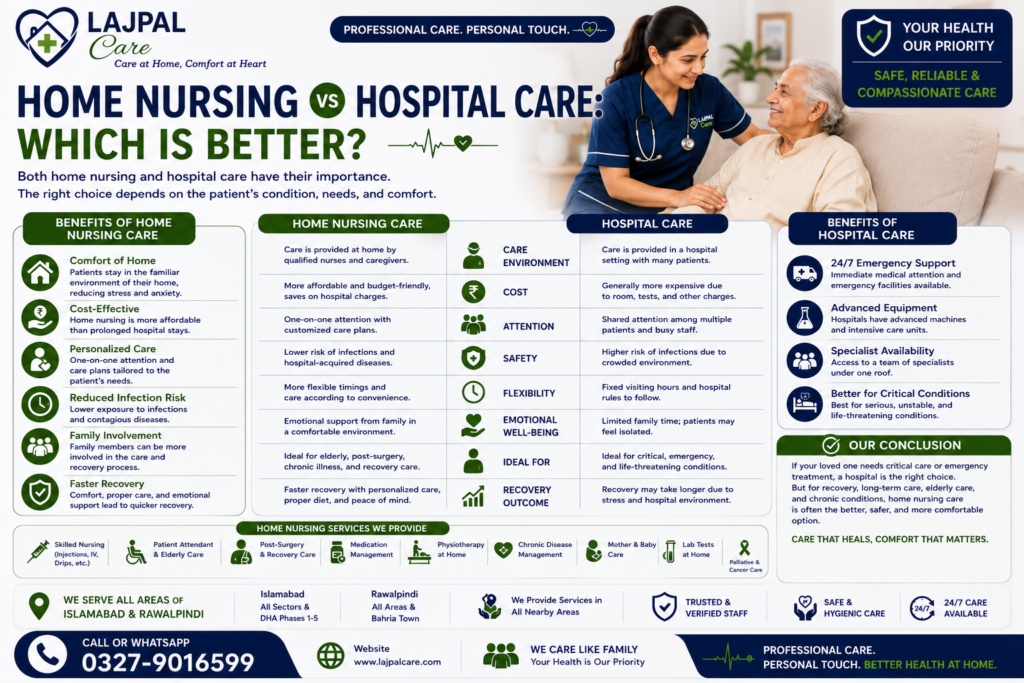
Home Nursing vs Hospital Care: Which Is Better?

Home Nursing vs Hospital Care: Understanding the Difference

Choosing between Home Nursing vs Hospital Care is one of the most important healthcare decisions a family may face. The right choice depends on the patient’s medical condition, treatment plan, level of monitoring required, and recommendations from the treating physician.

For patients who need emergency treatment, surgery, or intensive medical intervention, hospital care is essential. However, many medically stable patients can continue their recovery safely at home with professional Home Nursing Services.

This guide compares Home Nursing vs Hospital Care to help families understand the advantages and limitations of each option.


Table of Contents

  • What Is Home Nursing?

  • What Is Hospital Care?

  • Home Nursing vs Hospital Care for Recovery

  • Home Nursing vs Hospital Care for Elderly Patients

  • Home Nursing vs Hospital Care After Surgery

  • Home Nursing vs Hospital Care for Long-Term Conditions

  • Benefits of Home Nursing

  • Benefits of Hospital Care

  • When Is Home Nursing the Better Choice?

  • When Is Hospital Care the Better Choice?

  • Frequently Asked Questions

  • Conclusion


What Is Home Nursing?

Home Nursing is a professional healthcare service delivered in the patient’s home by qualified nurses. Care is provided according to the patient’s medical needs and the treatment plan prescribed by the treating physician.

Home Nursing Services may include:

  • Medication administration as prescribed

  • Vital signs monitoring

  • Wound dressing

  • Injection and IV therapy

  • Catheter care

  • NG Tube and PEG Tube care

  • Oxygen therapy support

  • Bedridden patient care

  • Stroke patient care

  • Elderly care

  • Post-surgical nursing care


What Is Hospital Care?

Hospital Care refers to medical treatment provided in a healthcare facility where doctors, nurses, and specialists are available to manage emergencies, perform surgeries, provide intensive monitoring, and treat complex medical conditions.

Hospitals are designed for patients who require immediate medical intervention or specialized equipment that cannot be safely provided at home.


Home Nursing vs Hospital Care for Recovery

When comparing Home Nursing vs Hospital Care for recovery, many medically stable patients benefit from continuing treatment at home after discharge.

Home Nursing may provide:

  • A familiar and comfortable environment

  • Personalized one-to-one attention

  • Better family involvement

  • Reduced travel for routine nursing procedures

  • Continuity of care after hospital discharge

Hospital Care remains appropriate when continuous specialist supervision or emergency medical intervention is required.


Home Nursing vs Hospital Care for Elderly Patients

Many older adults prefer to remain in their own homes whenever possible.

For medically stable elderly patients, Home Nursing may support:

  • Medication management

  • Personal hygiene

  • Mobility assistance

  • Health monitoring

  • Fall prevention

  • Nutrition support

Hospital Care may be necessary if the patient develops an acute illness, severe infection, or another condition requiring inpatient treatment.


Home Nursing vs Hospital Care After Surgery

After surgery, the treating physician determines when a patient is ready to leave the hospital.

Once discharged, Home Nursing can assist with:

  • Wound dressing

  • Medication support

  • Recovery monitoring

  • Mobility assistance

  • Infection prevention education

  • Follow-up care coordination

Patients with complications or unstable conditions may need to remain under hospital supervision until it is safe to return home.


Home Nursing vs Hospital Care for Long-Term Medical Conditions

Patients with long-term illnesses such as stroke, Parkinson’s disease, dementia, diabetes, or cancer often require ongoing support.

For many medically stable individuals, Home Nursing provides long-term assistance while allowing them to remain in familiar surroundings.

Hospital Care is generally reserved for periods when specialized medical treatment or emergency care becomes necessary.


Benefits of Home Nursing

Professional Home Nursing offers several important advantages:

  • Personalized patient care

  • Recovery in a familiar environment

  • Greater comfort and privacy

  • Flexible 12-hour and 24-hour care options

  • Better family participation

  • Reduced unnecessary hospital visits

  • Ongoing monitoring according to the care plan


Benefits of Hospital Care

Hospital Care provides:

  • Emergency medical treatment

  • Access to specialists

  • Surgical facilities

  • Intensive care services

  • Advanced diagnostic equipment

  • Continuous inpatient monitoring for critically ill patients

These services are essential when a patient’s condition cannot be safely managed at home.


When Is Home Nursing the Better Choice?

Home Nursing may be appropriate when a patient:

  • Has been discharged from the hospital

  • Is medically stable

  • Requires professional nursing procedures

  • Needs elderly care

  • Requires long-term support

  • Needs rehabilitation assistance

  • Prefers recovering at home

The decision should always be made in consultation with the treating physician.


When Is Hospital Care the Better Choice?

Hospital Care is generally more appropriate when a patient:

  • Requires emergency treatment

  • Needs surgery

  • Is critically ill

  • Requires intensive monitoring

  • Has rapidly changing medical needs

  • Needs specialized inpatient treatment


Frequently Asked Questions About Home Nursing vs Hospital Care

Is Home Nursing better than Hospital Care?

Neither option is universally better. The most appropriate choice depends on the patient’s medical condition, treatment goals, and the recommendations of the treating physician.

Can patients recover faster with Home Nursing?

Many medically stable patients appreciate recovering at home because of the familiar environment and individualized care. Recovery outcomes depend on many factors, including the patient’s condition and adherence to the prescribed treatment plan.

Is Hospital Care always necessary after surgery?

Not always. Many patients are discharged once it is medically safe to continue recovery at home with appropriate nursing support.

Can elderly patients receive professional care at home?

Yes. Home Nursing can provide medication support, health monitoring, mobility assistance, and personal care for medically stable elderly patients.

How do I decide between Home Nursing and Hospital Care?

Discuss the patient’s condition with the treating physician. They can recommend whether hospital treatment or professional Home Nursing is the safest and most appropriate option.


Conclusion

The comparison of Home Nursing vs Hospital Care shows that both play essential roles in patient care. Hospitals provide life-saving treatment, emergency care, surgery, and intensive monitoring when required. Home Nursing offers personalized healthcare, comfort, continuity of care, and professional support for many medically stable patients recovering at home.

The best choice depends on the patient’s individual healthcare needs and should always be guided by qualified medical advice.


Suggested Internal Links

Link this article to:

  • What Are Home Nursing Services?

  • Benefits of Home Nursing Services

  • How to Choose the Best Home Nurse

  • When Should You Hire a Home Nurse?

  • Home Nursing Services

  • Home Patient Care Services

  • Hospital Discharge Care

  • ICU Care at Home

  • Bedridden Patient Care

  • Stroke Patient Care

  • Elderly Care at Home

  • Patient Attendant Services


Website: https://homepatientcareservices.com
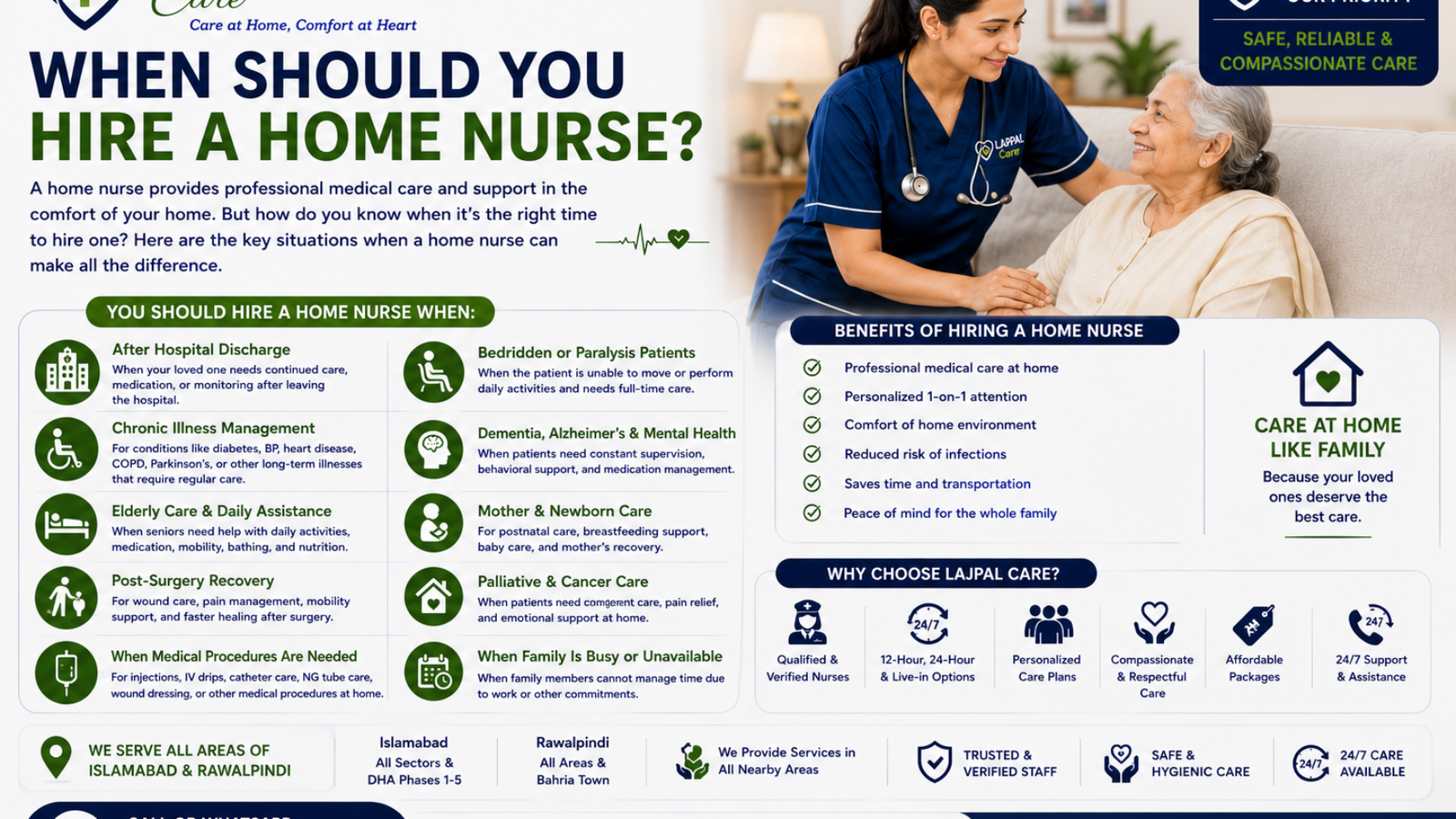
When Should You Hire a Home Nurse? Signs Your Loved One May Need Professional Care

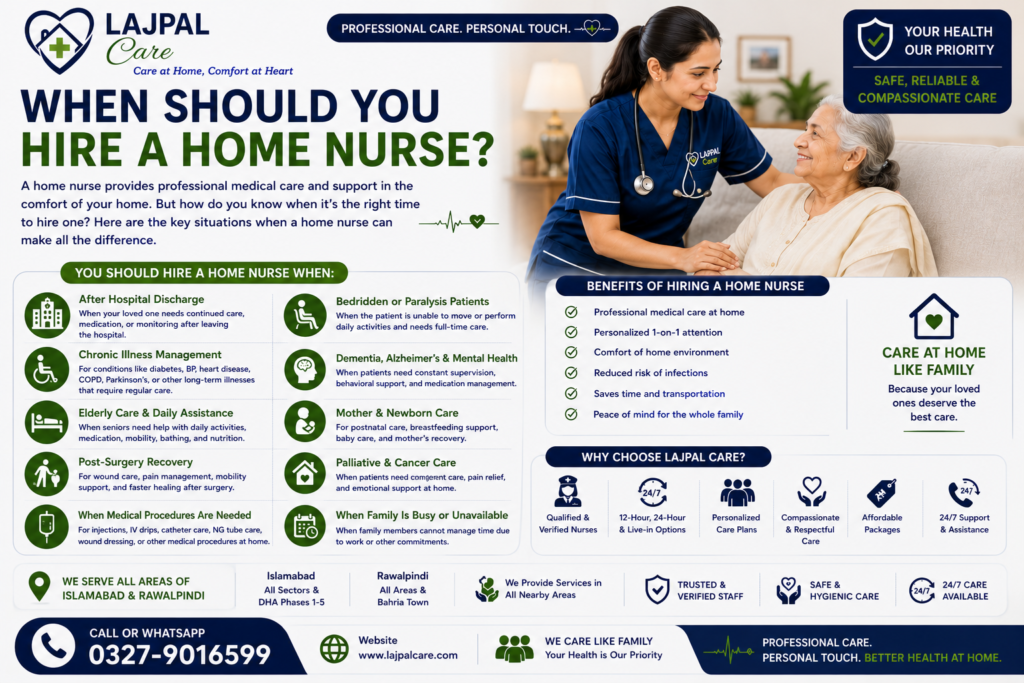
When Should You Hire a Home Nurse?

When Should You Hire a Home Nurse?

Deciding when to hire a home nurse is an important healthcare decision for any family. Many people wait until a medical condition becomes difficult to manage, but professional home nursing can often provide valuable support much earlier in the recovery process.

A qualified home nurse can help patients recover safely at home, monitor their condition, provide prescribed nursing care, and assist families in managing day-to-day healthcare needs. Understanding the situations in which home nursing may be appropriate can help families make informed decisions.


Table of Contents

  • What Does a Home Nurse Do?

  • Signs You May Need a Home Nurse

  • Medical Conditions That May Require Home Nursing

  • Benefits of Hiring a Home Nurse

  • Short-Term vs Long-Term Home Nursing

  • Questions to Ask Before Hiring

  • Frequently Asked Questions

  • Conclusion


What Does a Home Nurse Do?

A home nurse provides professional nursing care in the patient’s home according to the treatment plan prescribed by the treating physician. Depending on the patient’s condition, services may include:

  • Medication administration as prescribed

  • Vital signs monitoring

  • Wound dressing

  • Injection and IV therapy

  • Catheter care

  • NG Tube and PEG Tube care

  • Oxygen therapy support

  • Tracheostomy care

  • Post-surgical nursing care

  • Patient and family education

  • Health monitoring and documentation


Signs You May Need a Home Nurse

Certain situations may indicate that professional home nursing support could be beneficial.

Recovery After Surgery

Patients recovering from major surgery may need assistance with wound care, medication schedules, mobility, and monitoring during the healing process.

Frequent Hospital Visits

If a patient regularly travels to a hospital for routine nursing procedures, some of these services may be safely provided at home when clinically appropriate.

Difficulty Managing Medications

Patients taking multiple prescribed medications may benefit from professional nursing support to help follow treatment schedules and observe for possible concerns.

Reduced Mobility

People who have difficulty walking, standing, or moving independently often require assistance with safe transfers, hygiene, and daily care.

Chronic Medical Conditions

Patients living with long-term conditions such as diabetes, Parkinson’s disease, COPD, or heart disease may require ongoing nursing support as recommended by their healthcare team.

Elderly Patients Living Alone

Older adults who have limited mobility or require regular health monitoring may benefit from scheduled home nursing visits and personal care support.

Bedridden Patients

Patients confined to bed often require regular repositioning, skin care, hygiene support, feeding assistance, and monitoring to reduce the risk of complications.

Stroke Recovery

Many stroke survivors require ongoing nursing care, mobility assistance, and rehabilitation support after leaving the hospital.

Hospital Discharge

Patients discharged after serious illness or surgery may require temporary nursing care to continue their recovery safely at home.


Medical Conditions That May Require Home Nursing

Professional home nursing is commonly used for patients with:

  • Stroke

  • Cancer

  • Parkinson’s disease

  • Alzheimer’s disease

  • Dementia

  • Diabetes

  • COPD

  • Kidney disease

  • Heart disease

  • Post-operative recovery

  • Neurological disorders

  • Long-term mobility limitations

The need for home nursing depends on the patient’s overall condition and should be determined in consultation with the treating physician.


Benefits of Hiring a Home Nurse

Professional home nursing offers several important benefits.

Personalized Care

Each patient receives care based on individual medical needs rather than a standard routine.

Comfortable Recovery

Patients often feel more relaxed while recovering in familiar surroundings with family support.

Continuous Monitoring

Regular observation helps identify changes in the patient’s condition so families can seek medical advice when needed.

Family Support

Home nurses provide practical guidance that helps family members participate confidently in daily patient care.

Flexible Care Plans

Services can often be arranged as:

  • Per-visit nursing

  • Daily visits

  • 12-hour nursing care

  • 24-hour nursing care

  • Long-term home nursing


Short-Term vs Long-Term Home Nursing

Some patients require nursing care only during recovery after surgery or hospital discharge. Others may need ongoing support because of chronic illness, disability, or age-related health conditions.

The duration of care should always be based on the patient’s healthcare needs and medical recommendations.


Questions to Ask Before Hiring a Home Nurse

Before choosing a home nursing provider, consider asking:

  • What experience do you have with my loved one’s condition?

  • What nursing procedures will be provided?

  • How will the patient’s progress be monitored?

  • Are emergency communication procedures available?

  • Can care plans be adjusted if the patient’s condition changes?

  • Are 12-hour and 24-hour services available?


Frequently Asked Questions

Is it too early to hire a home nurse after hospital discharge?

Many patients benefit from professional nursing support immediately after discharge, especially when they require wound care, medication management, or ongoing monitoring. The timing should follow the treating physician’s recommendations.

Can elderly people receive home nursing without being hospitalized first?

Yes. Home nursing may be appropriate for older adults who need regular healthcare support even if they have not recently been admitted to a hospital.

Do home nurses help with rehabilitation?

Home nurses can support recovery by assisting with prescribed care plans and coordinating with rehabilitation professionals where appropriate.

Can I hire a home nurse for only a few weeks?

Yes. Depending on the patient’s needs, home nursing may be arranged for short-term recovery or long-term ongoing care.

How do I know if my loved one needs professional nursing rather than a caregiver?

If the patient requires clinical nursing procedures such as medication administration, wound care, vital signs monitoring, catheter care, or other skilled nursing tasks, a qualified home nurse may be more appropriate. A healthcare professional can help determine the right level of care.


Conclusion

Hiring a home nurse at the right time can improve patient comfort, support recovery, and provide families with confidence that professional care is available at home. Whether the need is temporary after surgery or ongoing because of a chronic illness, skilled home nursing allows many medically stable patients to continue receiving quality care while remaining in familiar surroundings.


Suggested Internal Links

Connect this article with:

  • What Are Home Nursing Services?

  • Benefits of Home Nursing Services

  • How to Choose the Best Home Nurse

  • Home Nursing Services

  • Home Patient Care Services

  • Hospital Discharge Care

  • Bedridden Patient Care

  • Stroke Patient Care

  • Elderly Care at Home

  • ICU Care at Home

  • Patient Attendant Services


Website: https://homepatientcareservices.com
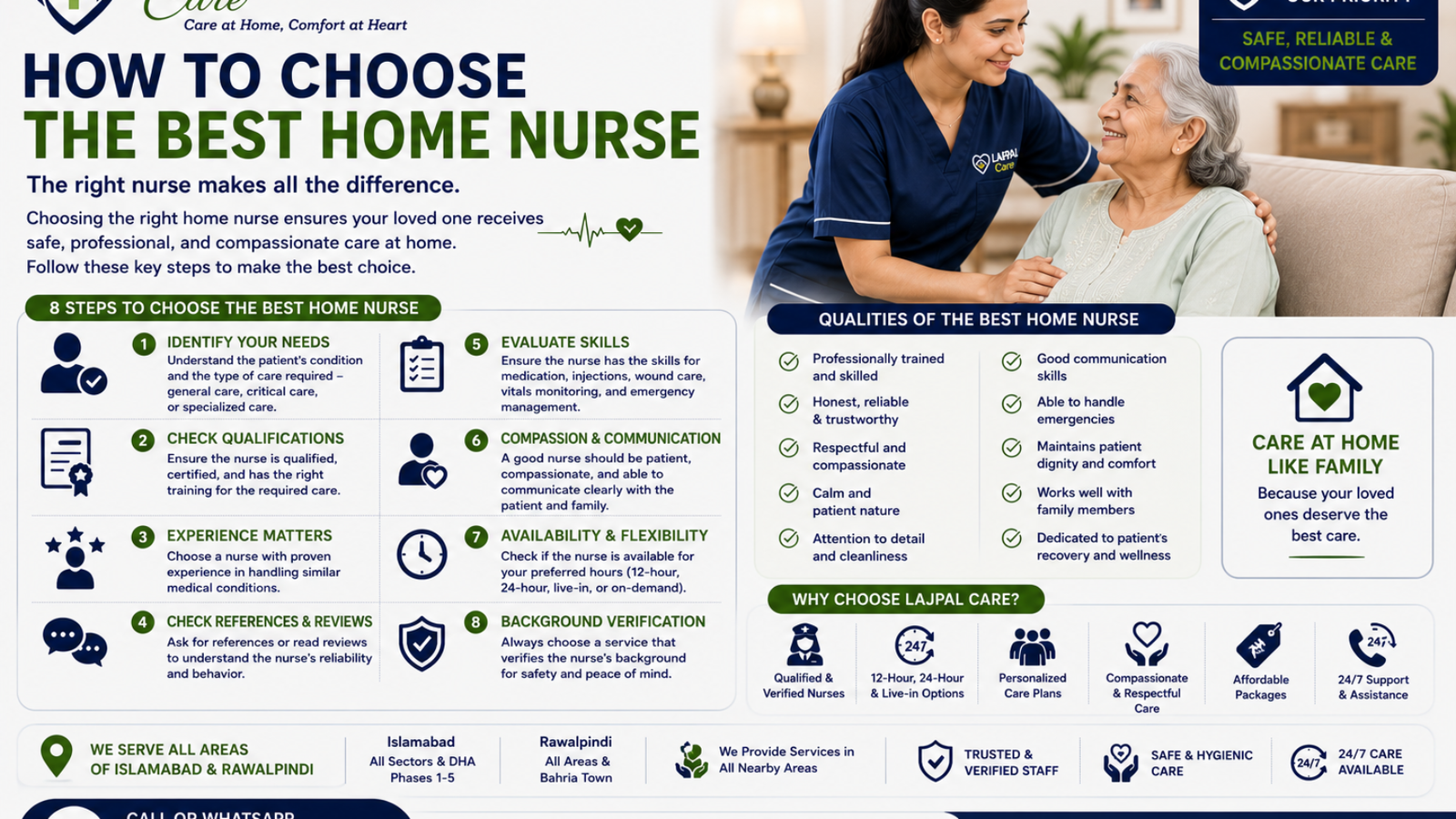
How to Choose the Best Home Nurse | A Complete Guide for Families

How to Choose the Best Home Nurse | A Complete Guide for Families

How to Choose the Best Home Nurse | A Complete Guide for Families


How to Choose the Best Home Nurse

Choosing the right home nurse is one of the most important decisions a family can make when a loved one needs professional healthcare at home. A qualified nurse not only provides medical support but also helps improve comfort, safety, and confidence during recovery.

Whether the patient is recovering after surgery, living with a chronic illness, or requiring long-term nursing care, selecting an experienced and compassionate nurse can make a meaningful difference. This guide explains the most important factors to consider before hiring Home Nursing Services.


Table of Contents

  • Why Choosing the Right Home Nurse Matters

  • Understand the Patient’s Care Needs

  • Verify Qualifications and Training

  • Look for Relevant Experience

  • Assess Communication Skills

  • Ask About Service Availability

  • Ensure Personalized Care Plans

  • Check Reputation and Reviews

  • Questions to Ask Before Hiring

  • Warning Signs to Avoid

  • Frequently Asked Questions

  • Conclusion


Why Choosing the Right Home Nurse Matters

Every patient has unique healthcare needs. Some require assistance with medication administration, while others need wound care, rehabilitation support, or long-term monitoring. Choosing a nurse with the right knowledge and experience helps ensure that care is delivered safely and according to the patient’s prescribed treatment plan.


Understand the Patient’s Care Needs

Before selecting a home nurse, identify the level of care required.

Examples include:

  • Post-surgical nursing care

  • Elderly care

  • Stroke patient care

  • Bedridden patient care

  • ICU or critical care support

  • Ventilator or tracheostomy care

  • Catheter or feeding tube care

  • Medication management

  • Long-term nursing care

Understanding these needs helps match the patient with an appropriately qualified nurse.


Verify Qualifications and Professional Training

Choose a nurse who has relevant education, professional training, and experience for the type of care required.

Depending on the patient’s condition, appropriate qualifications may include:

  • Registered nursing education

  • Clinical training relevant to the required care

  • Experience with home healthcare

  • Knowledge of infection prevention practices

  • Ability to monitor and document patient progress

If specialized procedures are required, confirm that the nurse has appropriate experience within their professional scope.


Look for Relevant Experience

Experience matters, especially for patients with complex healthcare needs.

Ask whether the nurse has previously cared for patients with conditions such as:

  • Stroke recovery

  • Bedridden care

  • Cancer care

  • Dementia or Alzheimer’s disease

  • Parkinson’s disease

  • Diabetes

  • Post-operative recovery

  • Respiratory conditions requiring oxygen therapy

Relevant experience helps the nurse recognize changes in the patient’s condition and provide consistent support.


Assess Communication Skills

A professional home nurse should communicate clearly with both the patient and family members.

Good communication includes:

  • Explaining care procedures in understandable language

  • Listening to patient concerns

  • Reporting significant changes to the treating physician or supervising healthcare team

  • Maintaining respectful and compassionate interactions

Effective communication builds trust and improves coordination of care.


Ask About Service Availability

Different patients require different schedules.

Before hiring, ask whether services are available as:

  • Per-visit nursing

  • Daily scheduled visits

  • Day shifts

  • Night shifts

  • 12-hour nursing services

  • 24-hour nursing services

  • Long-term home nursing

Choose a schedule that matches the patient’s medical and personal needs.


Ensure Personalized Care Plans

High-quality Home Nursing Services should be tailored to each patient rather than following a one-size-fits-all approach.

A personalized care plan may include:

  • Health monitoring

  • Medication support

  • Hygiene assistance

  • Nutrition support

  • Mobility assistance

  • Rehabilitation coordination

  • Family education

Care should always align with the recommendations of the patient’s treating physician.


Check Reputation and Reviews

Before selecting a home nursing provider, consider:

  • Verified patient feedback

  • Professional reputation

  • Responsiveness to inquiries

  • Clear communication about services

  • Transparent care processes

Reliable providers are generally open about their services and willing to answer questions before care begins.


Questions to Ask Before Hiring a Home Nurse

Consider asking the following questions:

  • What experience do you have with this type of patient?

  • What nursing services will you provide?

  • How will the patient’s condition be monitored?

  • How do you communicate important health changes?

  • Are flexible care schedules available?

  • How do you help families participate in patient care?

  • What happens if additional support is needed?

These questions can help families understand whether the service matches the patient’s needs.


Warning Signs to Avoid

Be cautious if a provider:

  • Cannot clearly explain the services offered.

  • Is unwilling to discuss staff qualifications or experience.

  • Does not communicate professionally.

  • Makes unrealistic promises or guarantees specific health outcomes.

  • Does not encourage coordination with the patient’s treating physician.

Choosing a reputable provider helps reduce misunderstandings and supports safer patient care.


Frequently Asked Questions

Should I hire a nurse or a caregiver?

It depends on the patient’s needs. A nurse is appropriate when professional nursing procedures or clinical monitoring are required. A caregiver generally assists with daily living activities such as personal hygiene, mobility, and companionship.

Can a home nurse care for elderly patients?

Yes. Many elderly individuals benefit from professional nursing support for medication management, health monitoring, mobility assistance, and ongoing care.

Do home nurses provide post-surgical care?

Yes. Home nurses may provide post-operative support such as wound care, medication administration, health monitoring, and recovery assistance according to the physician’s treatment plan.

Is it possible to hire a nurse for only a few hours each day?

Many home healthcare providers offer flexible care options, including scheduled visits, 12-hour shifts, and 24-hour services.

How do I know if my loved one needs a home nurse?

Patients recovering after surgery, managing chronic illnesses, requiring regular nursing procedures, or needing continuous medical observation may benefit from professional home nursing. The treating physician can help determine the appropriate level of care.


Conclusion

Choosing the best home nurse requires careful consideration of the patient’s healthcare needs, the nurse’s qualifications, relevant experience, communication skills, and the quality of the home healthcare provider. Taking the time to evaluate these factors helps families make informed decisions and ensures that patients receive compassionate, professional, and individualized care at home.


Suggested Internal Links

Link this article to:

  • What Are Home Nursing Services?

  • Benefits of Home Nursing Services

  • Home Nursing Services

  • Home Patient Care Services

  • Elderly Care at Home

  • Bedridden Patient Care

  • Stroke Patient Care

  • ICU Care at Home

  • Hospital Discharge Care

  • Patient Attendant Services


Website: https://homepatientcareservices.com
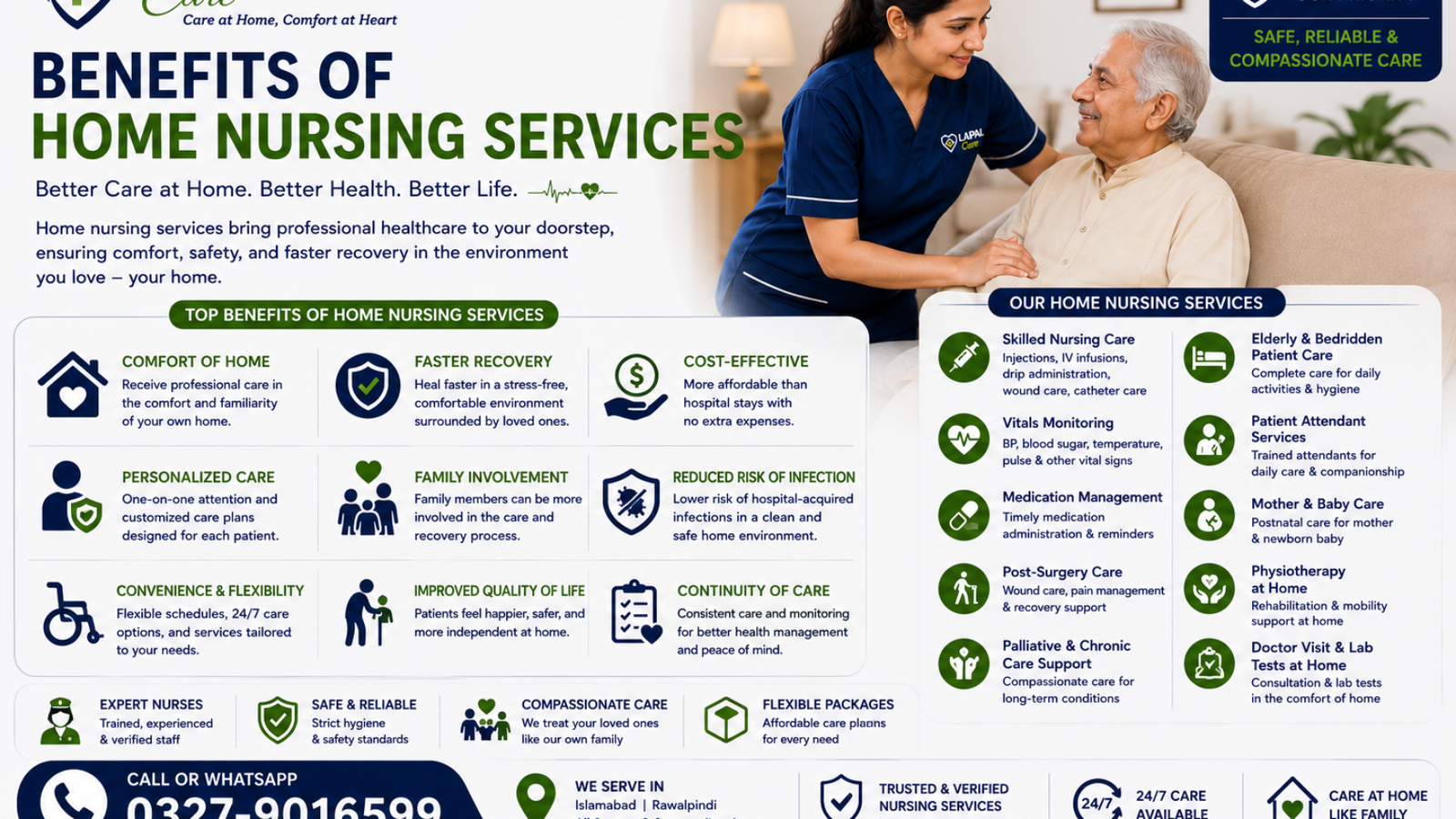
Benefits of Home Nursing Services | Why Professional Care at Home Matters

Benefits of Home Nursing Services | Why Professional Care at Home Matters

Benefits of Home Nursing Services

Home Nursing Services have become an essential part of modern healthcare, allowing patients to receive professional medical support without leaving the comfort of their homes. Whether a patient is recovering after surgery, managing a chronic illness, or requires long-term care, professional home nursing provides personalized healthcare while promoting comfort, safety, and independence.

For many medically stable patients, receiving care at home can improve the overall experience while reducing the stress often associated with prolonged hospital stays.


Table of Contents

  • What Are the Benefits of Home Nursing Services?

  • Personalized Patient Care

  • Faster Recovery in a Familiar Environment

  • Reduced Hospital Visits

  • Better Medication Management

  • Professional Monitoring

  • Support for Elderly Patients

  • Assistance for Bedridden Patients

  • Family Involvement

  • Flexible Care Plans

  • Improved Quality of Life

  • Frequently Asked Questions

  • Conclusion


Personalized One-to-One Care

One of the greatest advantages of Home Nursing Services is individualized care. Unlike busy hospital environments, home nurses can focus on a single patient’s specific healthcare needs.

Personalized care may include:

  • Monitoring vital signs

  • Administering prescribed medications

  • Assisting with daily activities

  • Supporting mobility

  • Providing hygiene care

  • Coordinating with the patient’s treatment plan


Faster Recovery in a Comfortable Home Environment

Many patients feel more relaxed and emotionally secure when recovering at home. Familiar surroundings, family support, and a comfortable routine can contribute to a positive recovery experience.

Home nursing helps patients continue their prescribed care while remaining in an environment that promotes comfort and confidence.


Reduced Hospital Visits

Professional home nursing can reduce the need for unnecessary hospital visits for medically stable patients.

Many nursing procedures can be performed safely at home, including:

  • Wound dressing

  • Injection services

  • IV therapy

  • Blood pressure monitoring

  • Blood sugar monitoring

  • Catheter care

  • NG Tube care

  • Oxygen therapy support

This allows patients to receive appropriate care while avoiding unnecessary travel whenever clinically suitable.


Professional Health Monitoring

Home nurses regularly observe the patient’s condition and document important changes that can be shared with the treating healthcare provider.

Monitoring may include:

  • Blood pressure

  • Pulse rate

  • Body temperature

  • Oxygen saturation

  • Blood glucose levels

  • Fluid intake and output

  • General patient condition

Early recognition of changes can help families seek timely medical advice when needed.


Better Medication Management

Missing doses or taking medications incorrectly can affect recovery.

Professional nurses can help by:

  • Following prescribed medication schedules

  • Recording medication administration

  • Observing for possible side effects

  • Reporting concerns to the treating physician when appropriate

Medication decisions always remain under the supervision of the patient’s healthcare provider.


Safe Care for Elderly Patients

Older adults often require assistance with mobility, personal hygiene, nutrition, and routine health monitoring.

Home nursing can support elderly patients through:

  • Fall prevention assistance

  • Personal care

  • Mobility support

  • Nutrition monitoring

  • Medication reminders

  • Regular observation of general health

This enables many seniors to remain in their own homes while receiving appropriate support.


Specialized Support for Bedridden Patients

Patients confined to bed require consistent attention to reduce the risk of complications.

Professional home nursing may include:

  • Regular repositioning

  • Pressure injury prevention

  • Personal hygiene

  • Feeding assistance

  • Catheter care

  • Wound care

  • Mobility assistance where appropriate

These measures help improve patient comfort and support long-term care needs.


Family Participation in Patient Care

Home nursing encourages families to remain actively involved in the recovery process.

Professional nurses can educate family members about:

  • Safe patient handling

  • Hygiene practices

  • Medication schedules

  • Nutrition support

  • Recognizing warning signs

  • Daily care routines

This collaboration creates a more supportive care environment.


Flexible Nursing Care Plans

Every patient has different healthcare needs.

Professional Home Nursing Services often offer flexible options such as:

  • Per-visit nursing

  • Scheduled nursing visits

  • Daytime care

  • Overnight care

  • 12-hour nursing services

  • 24-hour nursing services

  • Long-term nursing support

Care plans should always be tailored to the patient’s medical condition and physician’s recommendations.


Improved Quality of Life

Professional home nursing focuses not only on medical treatment but also on patient comfort, dignity, and emotional well-being.

Benefits include:

  • Greater independence

  • Reduced stress

  • Personalized attention

  • Better comfort

  • Family support

  • Continuity of care

  • Improved confidence during recovery


Frequently Asked Questions

Are Home Nursing Services only for seriously ill patients?

No. Home nursing is suitable for many medically stable patients who require professional healthcare support, including elderly individuals, post-surgical patients, and people with chronic illnesses.

Can home nurses help after hospital discharge?

Yes. Many patients continue their recovery at home with nursing support following discharge, according to the recommendations of their treating physician.

Do Home Nursing Services improve recovery?

For many medically stable patients, professional nursing care at home can support recovery by providing consistent care, monitoring, and assistance with prescribed treatment plans.

Are Home Nursing Services available for short-term and long-term care?

Yes. Depending on the patient’s needs, services may be arranged for individual visits, temporary recovery, or ongoing long-term support.

Can families stay involved while a nurse is providing care?

Absolutely. Family participation is encouraged, and nurses often provide guidance to help relatives support the patient’s recovery safely.


Conclusion

Home Nursing Services provide patients with professional healthcare while allowing them to remain in the comfort of their own homes. From personalized nursing care and medication support to elderly care and post-hospital recovery, these services help many patients maintain comfort, dignity, and continuity of care.

When provided according to the patient’s medical needs and physician’s treatment plan, Home Nursing Services can be an important part of a safe and supportive recovery journey.


Suggested Internal Links

Link this article to:

  • What Are Home Nursing Services?

  • Home Nursing Services

  • Home Patient Care Services

  • Elderly Care at Home

  • Bedridden Patient Care

  • Stroke Patient Care

  • ICU Care at Home

  • Hospital Discharge Care

  • Patient Attendant Services


Website: https://homepatientcareservices.com
Benefits of Home Nursing Services | Why Professional Care at Home Matters

What Are Home Nursing Services? | Complete Guide to Home Patient Care

What Are Home Nursing Services? | Complete Guide to Home Patient Care

What Are Home Nursing Services?

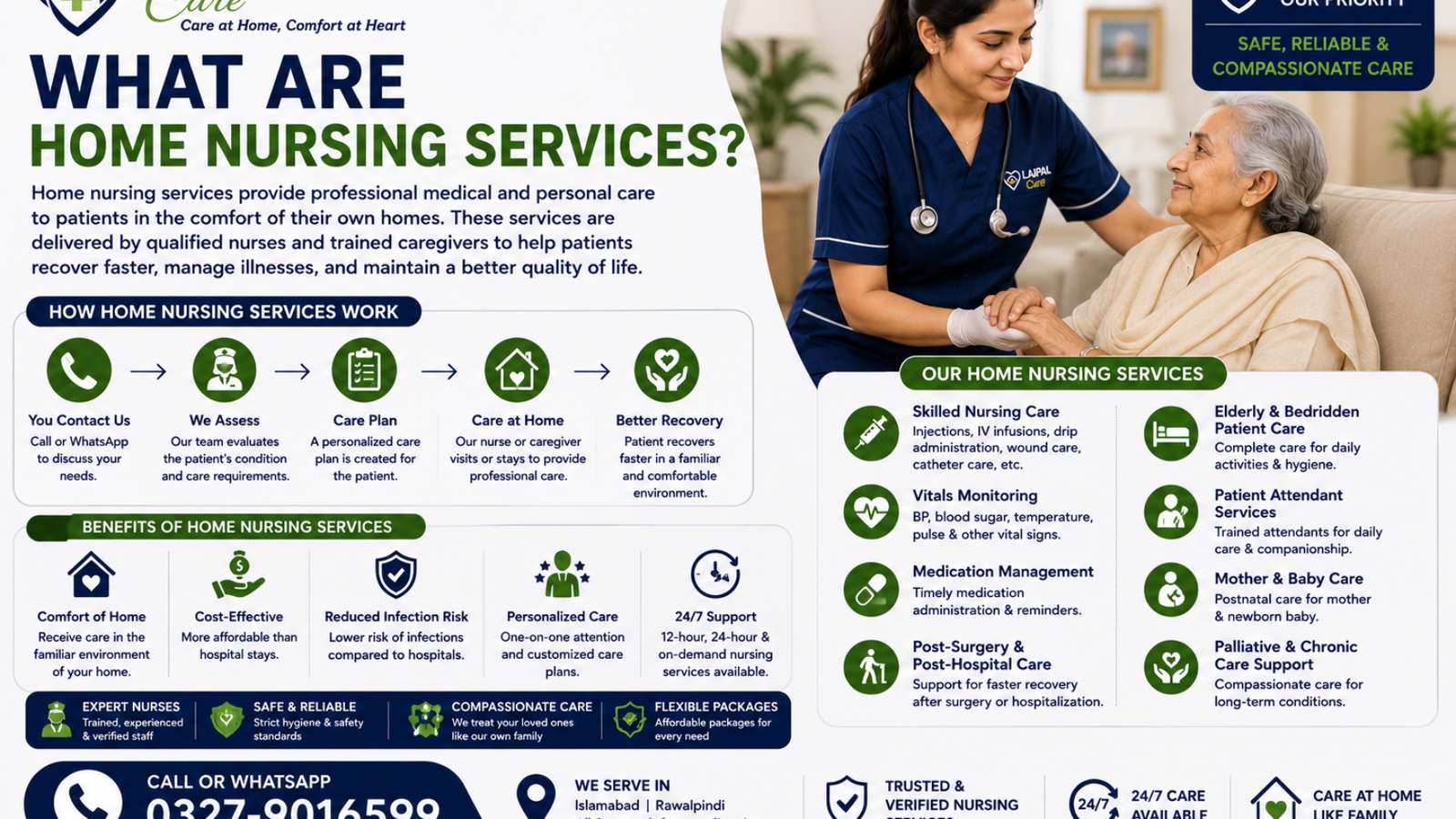
Home Nursing Services are professional healthcare services provided to patients in the comfort of their own homes by qualified nurses and trained caregivers. These services are designed for people who need medical attention, nursing procedures, rehabilitation support, or assistance with daily activities but do not require continuous hospitalization.

Home nursing allows patients to recover in a familiar environment while continuing the treatment plan recommended by their doctor. It is a practical option for elderly individuals, patients recovering after surgery, people living with chronic illnesses, and those who need long-term medical care.


Table of Contents

  • What Are Home Nursing Services?

  • Who Needs Home Nursing Services?

  • What Services Are Included?

  • Benefits of Home Nursing

  • Types of Home Nursing Services

  • Difference Between a Home Nurse and a Caregiver

  • Why Families Prefer Home Nursing

  • How to Choose the Right Home Nursing Provider

  • Frequently Asked Questions

  • Conclusion


Who Needs Home Nursing Services?

Home nursing can benefit many different patients, including:

  • Elderly people who need daily healthcare support.

  • Patients recovering after surgery.

  • Stroke patients.

  • Bedridden patients.

  • Cancer patients.

  • Individuals with Parkinson’s disease.

  • Patients living with Alzheimer’s or dementia.

  • Patients discharged from the ICU or hospital.

  • People requiring long-term medical monitoring at home.

Each patient has different healthcare needs, so professional care plans should always be tailored according to the advice of the treating physician.


What Services Are Included in Home Nursing?

Professional Home Nursing Services may include:

  • General nursing care

  • Medication administration (as prescribed)

  • Blood pressure and blood sugar monitoring

  • Injection and IV therapy

  • Wound dressing

  • Catheter care

  • NG Tube and PEG Tube care

  • Oxygen therapy support

  • Tracheostomy care

  • Nebulizer therapy

  • Feeding assistance

  • Bedridden patient care

  • Stroke patient care

  • Elderly care

  • Post-surgical care

  • Hospital discharge care

  • Palliative care

  • Patient attendant services

  • 12-hour and 24-hour nursing support

The exact services depend on the patient’s condition and medical requirements.


Benefits of Home Nursing Services

Professional home nursing offers many important advantages:

Comfortable Recovery

Patients often feel more relaxed and emotionally supported while recovering in their own homes.

Personalized Care

One-to-one attention allows nurses to focus entirely on the patient’s needs.

Reduced Hospital Visits

Many medically stable patients can continue treatment safely at home, reducing unnecessary hospital stays.

Family Involvement

Family members remain actively involved in the patient’s recovery while receiving guidance from healthcare professionals.

Better Quality of Life

Professional nursing helps improve comfort, dignity, independence, and overall well-being.


Types of Home Nursing Services

Home healthcare includes several specialized services, such as:

  • Skilled Nursing Care

  • Critical Care Nursing

  • ICU Care at Home

  • Ventilator Care

  • Elderly Home Care

  • Stroke Rehabilitation Support

  • Bedridden Patient Care

  • Cancer Patient Care

  • Palliative Care

  • Physiotherapy Support

  • Patient Attendant Services

These services can be arranged as one-time visits, scheduled visits, 12-hour shifts, or 24-hour home care, depending on the patient’s needs.


Home Nurse vs. Caregiver

Although both play an important role in home healthcare, their responsibilities are different.

A Home Nurse is trained to perform clinical nursing tasks such as medication administration, wound care, monitoring vital signs, catheter care, and other medical procedures within their professional scope.

A Caregiver primarily assists with personal care, mobility, feeding, hygiene, companionship, and daily living activities.

Many patients benefit from having both nursing care and caregiver support.


Why Families Choose Home Nursing

Families choose professional home nursing because it offers:

  • Safe recovery in familiar surroundings

  • Individualized healthcare

  • Professional monitoring

  • Flexible care schedules

  • Greater comfort for patients

  • Emotional support for families

  • Continuity of care after hospital discharge


How to Choose the Right Home Nursing Provider

When selecting a home nursing provider, consider:

  • Qualified and experienced nursing staff

  • Transparent communication

  • Personalized care plans

  • Availability of male and female nurses

  • Flexible scheduling options

  • Clear service policies

  • Positive reputation and patient satisfaction

  • Ongoing coordination with the patient’s treating physician


Frequently Asked Questions

Are Home Nursing Services only for elderly patients?

No. Home nursing is suitable for patients of different ages who require professional medical care at home.

Can I hire a nurse for only a few hours?

Many providers offer flexible options, including per-visit, 12-hour, and 24-hour services.

Can home nurses administer medications?

Yes, when medications have been prescribed by the treating physician and fall within the nurse’s professional responsibilities.

Is home nursing better than staying in the hospital?

For medically stable patients, home nursing can provide safe, comfortable, and personalized care while reducing unnecessary hospital stays. The most appropriate setting depends on the patient’s medical condition and the advice of their healthcare team.

How do I know if my family member needs home nursing?

Patients recovering from surgery, managing chronic illnesses, requiring rehabilitation, or needing regular nursing procedures may benefit from professional home nursing. A treating physician can help determine the most appropriate care.


Conclusion

Home Nursing Services provide professional healthcare for patients who need skilled medical support without remaining in the hospital. By combining qualified nursing care, personalized attention, and the comfort of home, these services help patients recover safely while improving their quality of life.

Choosing a trusted home nursing provider ensures that patients receive compassionate, professional care tailored to their individual healthcare needs.


Suggested Internal Links

  • Home Nursing Services

  • Home Patient Care Services

  • Elderly Care at Home

  • Bedridden Patient Care

  • Stroke Patient Care

  • ICU Care at Home

  • Hospital Discharge Care

  • Ventilator Care at Home

  • Tracheostomy Care at Home

  • Patient Attendant Services


Website: https://homepatientcareservices.com
Stroke Patient Care at Home | Professional Stroke Nursing & Rehabilitation Support

Stroke Patient Care at Home Professional Stroke Nursing

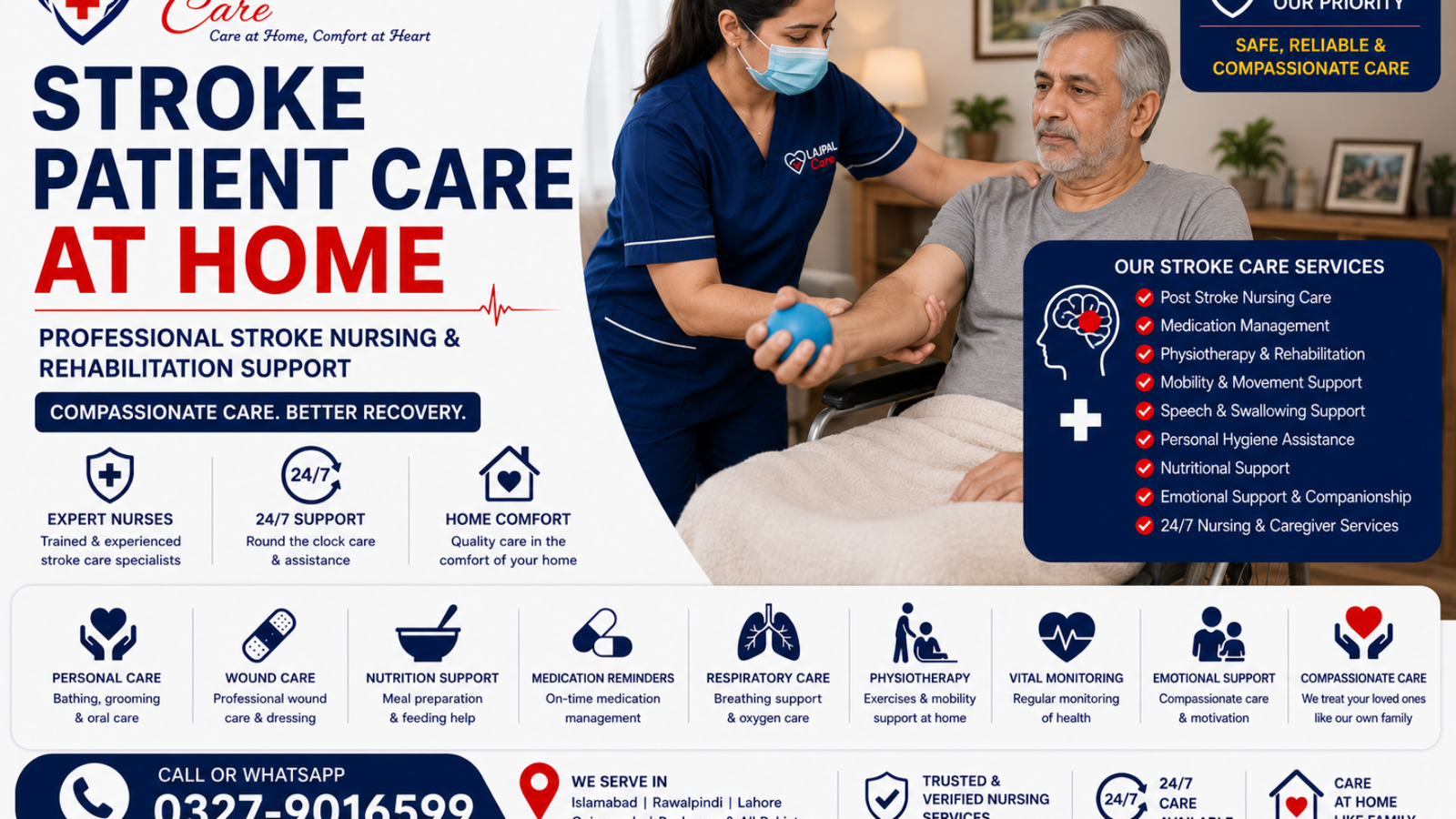
Professional Stroke Patient Care at Home

Recovering from a stroke requires skilled nursing care, rehabilitation support, patience, and continuous monitoring. Lajpal Care provides professional Stroke Patient Care at Home, helping stroke survivors receive compassionate healthcare in the comfort of their own homes while following the treatment plan prescribed by their treating physician.

Our experienced male and female nurses, caregivers, and patient attendants work closely with families to support recovery, improve comfort, and encourage independence wherever possible.

What Is Stroke Patient Care at Home?

Stroke Patient Care at Home is a specialized home healthcare service designed for individuals recovering from ischemic or hemorrhagic stroke. Many patients experience weakness, mobility limitations, speech difficulties, swallowing problems, or challenges with daily activities after a stroke.

Professional home nursing and caregiver support help patients continue their recovery safely while maintaining dignity and quality of life.

Our Stroke Patient Care Services

We provide comprehensive stroke home care services, including:

  • Professional home nursing care

  • Vital signs monitoring

  • Blood pressure and blood sugar monitoring

  • Medication administration as prescribed

  • Personal hygiene and bed bathing assistance

  • Feeding assistance

  • NG Tube and PEG Tube care

  • Catheter and Foley Catheter care

  • Wound dressing when required

  • Pressure injury (bed sore) prevention

  • Bedridden patient care

  • Safe patient positioning and mobility assistance

  • Passive range-of-motion exercises as advised by healthcare professionals

  • Oxygen therapy support

  • Nebulizer therapy when prescribed

  • Speech and rehabilitation support coordination where appropriate

  • Emotional support and companionship

  • Family education and caregiver guidance

  • 12-hour and 24-hour home nursing services

Who Can Benefit from Stroke Patient Care?

Our services are suitable for:

  • Patients recovering after a recent stroke

  • Patients with paralysis or weakness

  • Elderly stroke survivors

  • Patients requiring long-term nursing care

  • Individuals with swallowing or mobility difficulties

  • Bedridden stroke patients

  • Patients needing rehabilitation support at home

Why Choose Lajpal Care?

Families choose Lajpal Care because we provide personalized, compassionate, and professional home healthcare for stroke recovery.

Our Advantages

  • Qualified male and female nurses

  • Experienced caregivers and patient attendants

  • Personalized care plans

  • Per-visit, 12-hour, and 24-hour care options

  • Care based on physician recommendations

  • Infection prevention practices

  • Regular health monitoring

  • Respectful and confidential patient care

Benefits of Stroke Patient Care at Home

Professional home care can help:

  • Support recovery in a familiar environment

  • Improve patient comfort

  • Encourage safe mobility

  • Reduce the risk of pressure injuries

  • Assist with medication and nutrition

  • Promote family involvement in care

  • Reduce unnecessary hospital visits

  • Maintain continuity of care after hospital discharge

Common Challenges After a Stroke

Stroke survivors may experience:

  • Weakness on one side of the body

  • Difficulty walking

  • Problems with speech or communication

  • Swallowing difficulties

  • Balance and coordination issues

  • Fatigue

  • Memory or concentration problems

  • Reduced independence in daily activities

Our home care team provides supportive nursing care tailored to these challenges while working within the patient’s prescribed care plan.

Frequently Asked Questions

What services are included in Stroke Patient Care?

Our services include skilled nursing care, medication support, hygiene assistance, mobility support, feeding assistance, catheter care, vital signs monitoring, pressure injury prevention, and other nursing services according to the patient’s treatment plan.

Do you provide 12-hour and 24-hour stroke care?

Yes. We offer flexible care options, including scheduled visits, 12-hour shifts, and 24-hour home nursing services.

Can stroke patients receive care at home?

Many medically stable stroke patients can safely recover at home with professional nursing support and regular follow-up from their treating healthcare providers.

Do you provide physiotherapy?

Where needed, we can coordinate rehabilitation support as part of the patient’s overall care plan. Specific therapy should be provided by appropriately qualified rehabilitation professionals.

How can I book Stroke Patient Care at Home?

Contact Lajpal Care, share the patient’s diagnosis and current care requirements, and our team will recommend a personalized home care plan based on the patient’s condition.

Contact Lajpal Care

If your loved one requires professional Stroke Patient Care at Home, Lajpal Care provides experienced nurses, compassionate caregivers, and personalized home healthcare to support recovery, comfort, and quality of life. Every care plan is delivered according to the recommendations of the patient’s treating physician and individual healthcare needs.

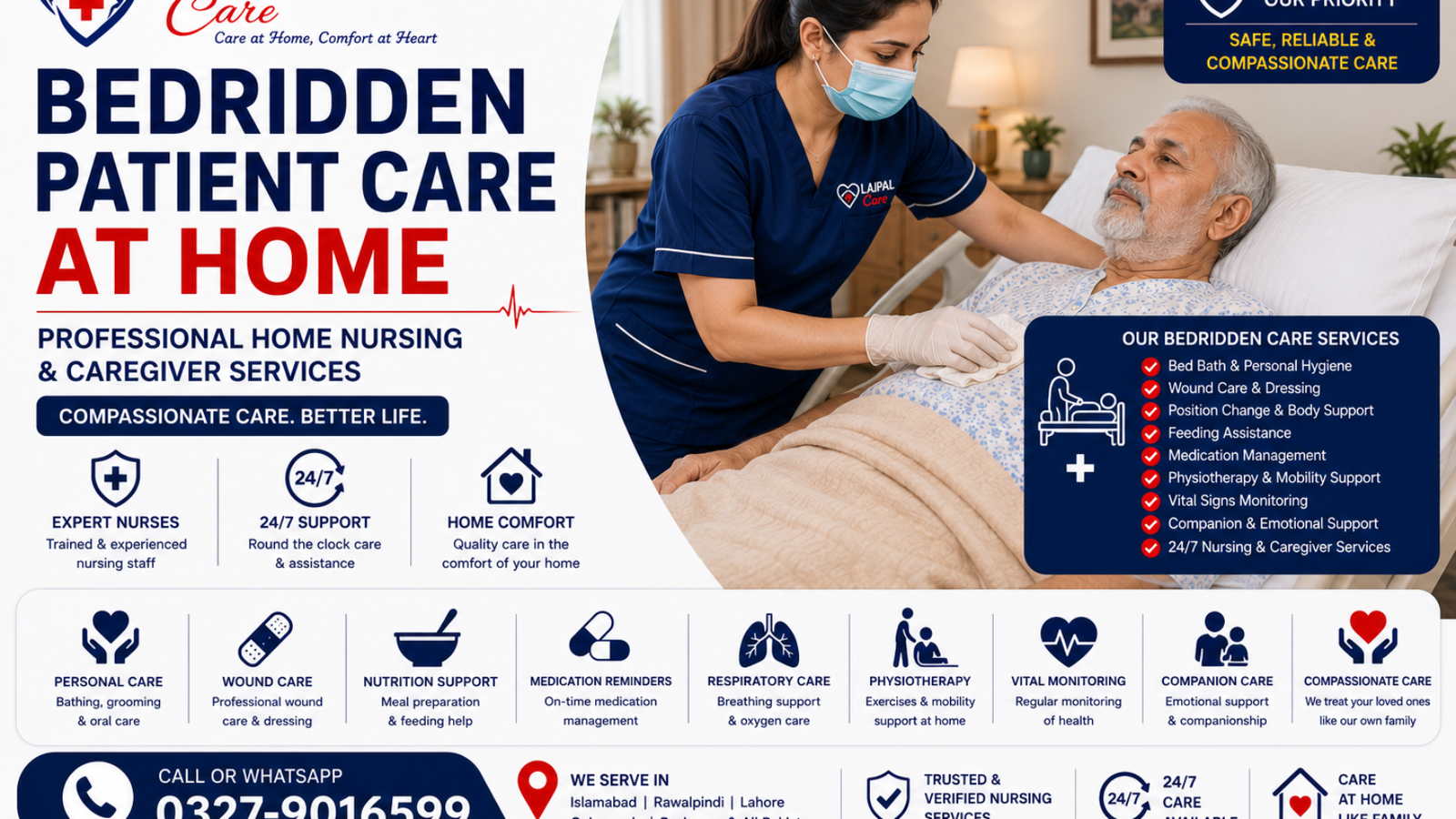
Bedridden Patient Care at Home | Professional Home Nursing & Caregiver Services

Bedridden Patient Care at Home Professional Home Nursing & Caregiver Services

Professional Bedridden Patient Care at Home

Caring for a bedridden patient requires patience, experience, and professional nursing support. Lajpal Care provides compassionate Bedridden Patient Care at Home, helping patients receive high-quality healthcare in the comfort and safety of their own homes.

Our qualified male and female nurses, caregivers, and patient attendants work according to the patient’s medical condition and the treatment plan prescribed by the treating physician. We focus on improving comfort, preventing complications, and supporting families with reliable home healthcare.

What Is Bedridden Patient Care?

Bedridden Patient Care is a specialized home healthcare service for individuals who are unable to leave their bed because of illness, surgery, stroke, advanced age, neurological conditions, or long-term disability. Professional nursing care helps maintain hygiene, mobility, nutrition, skin health, and overall well-being while reducing the risk of preventable complications.

Our Bedridden Patient Care Services

Our comprehensive home care services include:

  • Professional home nursing care

  • Personal hygiene and bed bathing assistance

  • Oral hygiene support

  • Safe patient repositioning

  • Pressure injury (bed sore) prevention

  • Bed sore care according to the treatment plan

  • Medication administration as prescribed

  • Blood pressure, pulse, temperature, and oxygen saturation monitoring

  • Blood sugar monitoring

  • Feeding assistance

  • NG Tube and PEG Tube care

  • Catheter and Foley Catheter care

  • Tracheostomy care

  • Oxygen therapy support

  • Nebulizer therapy

  • Wound dressing and wound care

  • Mobility and transfer assistance

  • Passive range-of-motion exercises as advised by healthcare professionals

  • Bowel and bladder care

  • Emotional support and companionship

  • Family education and caregiver guidance

  • 12-hour and 24-hour home nursing services

Who Can Benefit from Bedridden Patient Care?

Our services are suitable for:

  • Stroke patients

  • Elderly patients with limited mobility

  • Patients recovering after major surgery

  • Cancer patients

  • Parkinson’s disease patients

  • Alzheimer’s and dementia patients

  • Patients with spinal cord injuries

  • Individuals with neurological disorders

  • Patients requiring long-term nursing care at home

Why Choose Lajpal Care?

Families trust Lajpal Care because we provide personalized home healthcare with compassion, professionalism, and respect.

Our Advantages

  • Qualified male and female nurses

  • Experienced caregivers and patient attendants

  • Individualized care plans

  • Per-visit, 12-hour, and 24-hour care options

  • Care delivered according to physician recommendations

  • Infection prevention practices

  • Regular health monitoring

  • Respectful, confidential, and compassionate support

Benefits of Professional Bedridden Patient Care

Professional home care can help:

  • Improve patient comfort

  • Reduce the risk of pressure injuries

  • Support safe recovery at home

  • Maintain personal hygiene and dignity

  • Assist with medication and nutrition

  • Encourage family participation in care

  • Reduce unnecessary hospital visits

  • Promote continuity of care

Conditions Commonly Requiring Bedridden Patient Care

Patients may require professional bedside care due to:

  • Stroke recovery

  • Advanced neurological disorders

  • Severe arthritis and mobility limitations

  • Hip fracture recovery

  • Post-surgical recovery

  • Advanced cancer

  • Chronic respiratory diseases

  • Long-term disability

  • Age-related frailty

Why Home Care Is Beneficial for Bedridden Patients

Many medically stable bedridden patients recover more comfortably at home with professional nursing support. Home-based care allows families to stay involved while patients receive individualized attention in a familiar environment.

Frequently Asked Questions

What services are included in Bedridden Patient Care?

Our services include personal hygiene, repositioning, pressure injury prevention, medication support, feeding assistance, catheter care, wound dressing, vital signs monitoring, and other nursing services according to the patient’s treatment plan.

Do you provide male and female caregivers?

Yes. We provide both male and female nurses and caregivers, depending on the patient’s preference, clinical needs, and staff availability.

Can I hire a caregiver for 12 or 24 hours?

Yes. We offer flexible care plans, including scheduled visits, 12-hour shifts, and 24-hour home nursing services.

Can bedridden patients receive long-term home care?

Yes. Many patients require ongoing home nursing and caregiver support for weeks, months, or longer, depending on their medical condition and the recommendations of their healthcare team.

How can I book Bedridden Patient Care at Home?

Contact Lajpal Care, provide the patient’s diagnosis and care requirements, and our team will recommend a personalized home care plan that matches the patient’s needs.

Contact Lajpal Care

If your loved one requires professional Bedridden Patient Care at Home, Lajpal Care is committed to providing compassionate, reliable, and high-quality home nursing services. Our experienced nurses and caregivers help patients receive safe, dignified, and personalized care at home while following the treatment plan prescribed by their treating physician.

Emergency Home Nursing Care Services in Rawalpindi (24/7 Support)

Emergency Home Nursing Care Services in Rawalpindi (24/7 Support)

Medical emergencies never come with a warning. Whether it’s late at night, after a hospital discharge, or a sudden decline in a patient’s condition, families often find themselves in urgent need of professional medical support.

This is where emergency home nursing care services in Rawalpindi become a lifeline. Instead of rushing to overcrowded hospitals, you can now get trained nurses at your doorstep — quickly, safely, and professionally.

With growing healthcare needs in Rawalpindi, more families are choosing emergency home care as a reliable and immediate solution.

???? What Are Emergency Home Nursing Care Services?

Emergency home nursing care means fast-response medical assistance provided at home by qualified nurses when time is critical.

These services are designed for patients who:

  • Need urgent medical attention

  • Cannot be moved easily to a hospital

  • Require immediate post-discharge care

  • Are facing sudden health complications

The goal is simple: deliver hospital-level care at home without delay.


⚡ When Do You Need Emergency Home Nursing?

You should consider emergency home nursing services in Rawalpindi in situations like:

  • Sudden breathing problems

  • High fever or infection

  • Stroke symptoms (weakness, speech issues)

  • Post-surgery complications

  • Oxygen requirement

  • Uncontrolled blood pressure or sugar

  • Severe weakness in elderly patients

Quick action in these situations can make a real difference in recovery.

Services Included in Emergency Home Nursing

Emergency home nursing services cover a wide range of medical care depending on the patient’s condition.

Immediate Health Assessment

  • Checking vital signs

  • Evaluating patient condition

  • Identifying emergency risks

Injection & IV Drip Services

  • Emergency injections

  • IV medications

  • Pain and infection control

Oxygen Therapy at Home

  • Oxygen setup

  • Monitoring oxygen levels

  • Support for breathing issues

Wound Care & Dressing

  • Post-surgical dressing

  • Infection prevention

  • Emergency wound management

ICU-Level Care at Home

  • Continuous monitoring

  • Suction support

  • Tracheostomy care

  • Catheter management

24/7 Nursing Support

  • Day and night availability

  • Continuous care

  • Emergency readiness


Benefits of Emergency Home Nursing Care

⏱️ Fast Response

No waiting in hospital queues — care comes directly to your home.

???? Comfort & Convenience

Patients stay in a familiar environment, reducing stress and anxiety.

????‍⚕️ Professional Care

Qualified nurses ensure proper treatment and monitoring.

????️ Reduced Risk of Infection

Avoid exposure to hospital-based infections.

❤️ Personalized Attention

One-to-one care leads to better patient outcomes.

Who Needs Emergency Home Nursing?

Emergency home nursing is especially helpful for:

  • Elderly patients

  • Stroke or paralysis patients

  • Cancer patients

  • Post-surgery patients

  • ICU discharge patients

  • Bedridden individuals

These patients often need immediate and continuous medical supervision.

Areas We Cover in Rawalpindi

Emergency home nursing services are available across all major areas of Rawalpindi including:

  • Satellite Town

  • Saddar

  • Chaklala Scheme

  • Bahria Town

  • DHA Phase 1–6

  • Gulrez Housing Scheme

  • Westridge

Our team ensures quick arrival and reliable service across the city.


Trusted Emergency Care Provider

Lajpal Care Private Limited Company provides fast and dependable emergency home nursing care services in Rawalpindi.

Our services include:

  • 24/7 emergency nursing care

  • ICU care at home

  • Oxygen and critical care support

  • Stroke and cancer patient care

  • Post-hospital recovery services

We focus on speed, safety, and compassionate care.

Why Immediate Care Is Important

Delaying treatment in emergencies can lead to:

  • Serious health complications

  • Hospital admissions

  • Increased recovery time

  • Life-threatening situations

Emergency home nursing ensures timely medical attention when it matters most.

???? Contact for Emergency Home Nursing Services

Lajpal Care Private Limited Company
???? 0327 9016599
???? lajpalcare22@gmail.com
???? HomePatientCareServices.com
???? Office No 1, First Floor, Ayesha Plaza, Near Main Car Chowk, Gulrez Housing Scheme, Rawalpindi

Home Nursing Services24/7 Male-Female Nursing StaffHome Patient Care services Patient Attendant ServicesNew Born Baby Care ServicesHome Disable Care ServicesHome Elderly Care ServicesHome Physio ServicesBuy a Medical Bed or MoreDaily or Per Visit ServicesHome Care ServicesAll Domestic Staff

Facebook  |  Instagram  | Youtube

Urgent Home Nursing Services in Islamabad (24/7 Fast Care)

Urgent Home Nursing Services in Islamabad (24/7 Fast Care)

Medical emergencies can happen at any time — whether it is late at night, after hospital discharge, or during sudden health deterioration. In such situations, families often struggle to find immediate medical support.

This is where urgent home nursing services in Islamabad play a critical role. These services provide quick, professional, and reliable nursing care at home, ensuring patients receive immediate attention without delays.

In a fast-growing healthcare environment like Islamabad, access to emergency home care has become essential for families seeking safe and timely medical support.


???? What Are Urgent Home Nursing Services?

Urgent home nursing services refer to rapid-response medical care provided at home by trained nurses in emergency or time-sensitive situations.

These services are designed for patients who:

  • Need immediate medical attention

  • Cannot be moved to a hospital quickly

  • Require post-discharge urgent care

  • Experience sudden worsening of health condition

The goal is to deliver hospital-level care at home without delay.

When Do You Need Urgent Home Nursing Services?

You should consider urgent home nursing in situations such as:

  • Sudden weakness or collapse

  • Breathing difficulty

  • High fever or infection

  • Post-surgery complications

  • Stroke symptoms

  • Oxygen requirement

  • Uncontrolled blood sugar or blood pressure

  • Emergency injections or IV medication

Quick response in such cases can prevent serious complications and save lives.


Services Included in Emergency Home Nursing

Urgent home nursing services in Islamabad include a wide range of medical and supportive care.

Immediate Patient Assessment
  • Initial health evaluation

  • Vital signs monitoring

  • Emergency condition analysis

IV Medication & Injections

  • Emergency IV drips

  • Pain management injections

  • Antibiotic administration

Oxygen Therapy Support
  • Oxygen cylinder setup

  • Oxygen level monitoring

  • Respiratory support

Wound Care & Dressing
  • Emergency dressing

  • Infection control

  • Post-surgical wound management

ICU-Level Care at Home

  • Continuous monitoring

  • Suction support

  • Tracheostomy care

  • Catheter management

24/7 Nursing Availability

  • Day and night shifts

  • Continuous patient monitoring

  • Emergency response readiness

Benefits of Urgent Home Nursing Services

⏱️ Fast Response Time

Immediate availability of nurses reduces delays in treatment.

???? Comfort of Home

Patients receive care in a familiar and stress-free environment.

????‍⚕️ Professional Medical Support

Qualified nurses ensure safe and accurate treatment.

????️ Reduced Hospital Burden

Avoid unnecessary hospital visits for manageable conditions.

❤️ Personalized Attention

One-to-one care improves patient outcomes and satisfaction.


???? Who Needs Emergency Home Nursing?

Urgent home nursing is ideal for:

  • Elderly patients living alone

  • Stroke or paralysis patients

  • Cancer patients needing urgent care

  • ICU discharge patients

  • Post-surgery patients

  • Bedridden individuals

  • Patients requiring oxygen support

These patients need immediate medical supervision that can be delivered at home.


Areas We Cover in Islamabad

Urgent home nursing services are available across all major sectors of Islamabad including:

  • G-10, G-11, G-13, G-14

  • F-10, F-11

  • I-8, I-10

  • DHA Islamabad

  • Bahria Town

  • Gulberg Greens

Quick response teams ensure timely arrival at your location.

Professional Emergency Home Care Provider

Lajpal Care Private Limited Company provides fast and reliable urgent home nursing services in Islamabad.

Our services include:

  • 24/7 emergency nursing

  • ICU care at home

  • Oxygen and critical care support

  • Stroke and cancer patient care

  • Post-hospital recovery services

We focus on rapid response, patient safety, and professional care.


Why Immediate Care Matters

Delays in medical attention can lead to:

  • Worsening of patient condition

  • Increased risk of complications

  • Emergency hospital admissions

  • Life-threatening situations

Urgent home nursing ensures timely intervention and better recovery outcomes.


???? Contact for Urgent Home Nursing Services

Lajpal Care Private Limited Company
???? 0327 9016599
???? lajpalcare22@gmail.com
???? HomePatientCareServices.com
???? Office No 1, First Floor, Ayesha Plaza, Near Main Car Chowk, Gulrez Housing Scheme, Rawalpindi, Pakistan

Conclusion

Urgent home nursing services in Islamabad provide a lifesaving solution for families dealing with medical emergencies at home. With quick response, professional care, and continuous monitoring, patients can receive immediate treatment without hospital delays.

Facebook  |  Instagram  |  Youtube

All Domestic Staff

Hospital Level Nursing Care at Home Islamabad

Hospital Level Nursing Care at Home Islamabad

Healthcare is evolving rapidly, and many families now prefer receiving advanced medical care in the comfort of their homes. Hospital level nursing care at home allows patients to receive professional medical treatment without staying in a hospital for long periods.

In modern healthcare systems, home-based medical care has become a reliable solution for patients who require continuous monitoring and skilled nursing services. Families in Islamabad are increasingly choosing hospital-level home care for better comfort, personalized attention, and faster recovery.

What Is Hospital Level Nursing Care at Home?

Hospital level nursing care at home refers to advanced medical services provided by trained nurses and healthcare professionals at a patient’s residence. These services are designed to offer the same level of professional care that patients typically receive in hospitals.

Such care is suitable for patients who require medical supervision but prefer to stay in a familiar home environment.

Home hospital care may include:

  • Continuous vital sign monitoring

  • IV medication administration

  • Oxygen therapy

  • Catheter management

  • Tracheostomy care

  • NG tube feeding

  • Wound dressing and infection control

  • Post-surgery monitoring

These services ensure that patients receive professional treatment while avoiding unnecessary hospital stays.

Patients Who May Need Hospital Level Care at Home

Hospital-level nursing care is ideal for patients who require specialized medical attention, including:

  • Stroke patients requiring continuous monitoring

  • Cancer patients undergoing recovery

  • Elderly individuals with complex health conditions

  • ICU discharge patients

  • Patients recovering after major surgery

  • Bedridden patients requiring full-time nursing support

Providing care at home allows patients to recover in a peaceful and comfortable environment.

Benefits of Hospital Level Nursing Care at Home

Personalized Medical Attention

In hospitals, nurses may care for several patients simultaneously. At home, patients receive one-to-one care, ensuring better monitoring and faster response to health changes.

Reduced Hospital Readmissions

Professional home monitoring helps detect complications early and prevents unnecessary hospital visits.

Comfort and Emotional Support

Patients feel more relaxed when surrounded by family members and familiar surroundings.

Lower Risk of Hospital Infections

Hospitals can expose patients to cross-infections. Home care significantly reduces this risk.

Faster Recovery

A calm home environment often contributes to quicker healing and improved patient morale.

24-Hour Nursing and Critical Care Support

Many patients who require hospital-level care also need 24-hour nursing supervision.

Professional home nursing services may include:

  • 12-hour nursing shifts

  • 24-hour continuous patient care

  • Night nursing supervision

  • Emergency response support

Continuous monitoring ensures that the patient’s health condition remains stable at all times.

Specialized Home Medical Services

Advanced home healthcare providers offer specialized medical support such as:

  • ICU-level patient care at home

  • Oxygen therapy management

  • Suction procedures

  • Tracheostomy tube care

  • Catheter and urinary care

  • Post-surgical wound management

  • Medication administration and monitoring

These services bring hospital-grade healthcare directly into the patient’s home.


Hospital Level Nursing Care Across Islamabad

Professional home healthcare services are available across many sectors of Islamabad including:

  • G-10, G-11, G-12, G-13, G-14

  • F-10, F-11

  • I-8, I-10

  • DHA Islamabad

  • Bahria Town

  • Gulberg Greens

Families in these areas rely on trained nurses to manage patient care safely at home.


Professional Home Healthcare Support

Trusted healthcare providers such as Lajpal Care Private Limited Company offer trained nursing staff capable of delivering hospital-standard medical care at home.

Their services may include:

  • Home nursing staff

  • Home patient attendants

  • Elderly care services

  • ICU patient support at home

  • Post-hospital recovery care

The goal is to provide safe, reliable, and compassionate healthcare support to patients and their families.

Hospital Level Nursing Care at Home Islamabad

Hospital level nursing care at home in Islamabad is transforming the way patients receive medical treatment. With professional nurses, advanced medical support, and personalized attention, patients can experience high-quality healthcare without leaving their homes.

For families seeking safe and professional patient care, hospital-level home nursing services offer comfort, convenience, and medical reliability.

Home Nursing Services24/7 Male-Female Nursing StaffHome Patient Care services Patient Attendant ServicesNew Born Baby Care ServicesHome Disable Care ServicesHome Elderly Care ServicesHome Physio ServicesBuy a Medical Bed or MoreDaily or Per Visit ServicesHome Care ServicesAll Domestic Staff

Facebook  |  Instagram  | Youtube